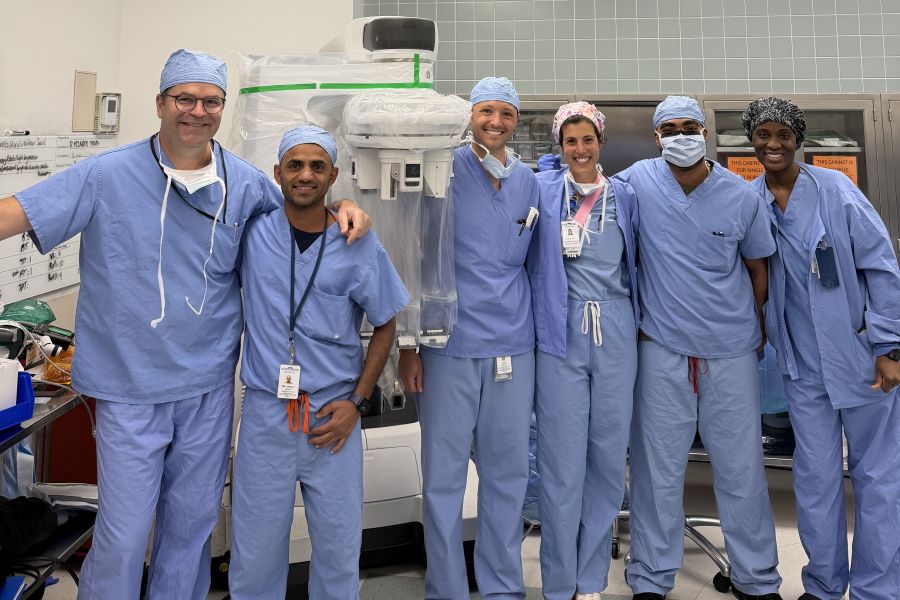
For years, minimally invasive robotic surgery has helped patients recover faster from thoracic procedures by replacing large incisions with several small ones. Now, a new generation of robotic technology is taking that approach a step further.
Northside Hospital recently performed its first single-incision (single-port) robotic thoracic surgery, expanding minimally invasive treatment options for patients with certain tumors and other conditions affecting the chest.
"The beneficiary of this technology is the patient, not the surgeon," said Dr. Misho Hubka, thoracic surgeon and medical director of Northside Thoracic Surgery. "The operation is actually technically more difficult with a single-port approach than with a multi-port approach. Our goal is to apply the least invasive and maximally safe and effective operation for each patient.
Additionally, "it's important to remember that these robotic systems are tools," Dr. Hubka said. "They're excellent tools that aid our dexterity inside the human body, but do not replace the expertise and the judgment of the surgeon."
Building on decades of surgical innovation
Thoracic surgery has evolved dramatically over the last several decades, progressing from traditional open operations to robotic-assisted minimally invasive procedures.
Open surgery for tumors in the chest often required splitting the breastbone or making large incisions between the ribs, resulting in longer hospital stays and recovery times. Multi-port robotic surgery significantly reduced that trauma by allowing surgeons to operate through several small incisions between the ribs.
Now, single-port technology allows surgeons to perform certain procedures through a single incision below the breastbone or beneath the rib cage. By avoiding the spaces between the ribs, the technique may reduce pain and trauma to the chest wall while giving surgeons a highly magnified, high-definition view of structures within the chest.
For procedures involving the mediastinum — the area between the lungs that contains the heart, trachea and other vital structures — the improved angle avoids the need to operate between the ribs. It also helps surgeons visualize important nerves that run along each side of the chest.
A thoughtful approach to innovation
Northside's first single-port thoracic procedure involved removing a thymoma, a tumor of the thymus gland located in the mediastinum. The operation took approximately 90 minutes, and the patient was discharged home the following day.
While introducing new technology is exciting, innovation is always paired with careful planning and patient safety. Before launching the program, Northside developed a phased implementation strategy that includes specialized training, simulation exercises, carefully selected patients and additional operating room resources during the team's early experience with the technology.
"Safety is our number one goal for our patients," Dr. Hubka said. "Recovery is important, and the oncologic effectiveness of the operation is important, but safety is the number one priority."
As robotic surgery technology advances, Dr. Hubka expects the single-port approach to be cleared for additional thoracic procedures, including certain operations involving the esophagus. Equally important, he said, is having the expertise to determine when single-port surgery is the right choice — and when another approach is better.
"Our patients benefit because our team is experienced with single-port, multi-port, video-assisted and open operations," Dr. Hubka said. "We have all the tools available to treat our patients, and we can apply the appropriate operation — the least invasive and maximally safe and effective operation."
That individualized approach is part of what distinguishes Northside's thoracic surgery program, where surgeons work alongside pulmonologists, medical oncologists, radiation oncologists, gastroenterologists and specialized nurses to coordinate each patient's care.
"Technology alone gives us a competitive advantage," Dr. Hubka said. "But where Northside really shines is that this technology is part of a much broader team-based approach."
LEARN MORE ABOUT THORACIC SURGERY AT NORTHSIDE.