
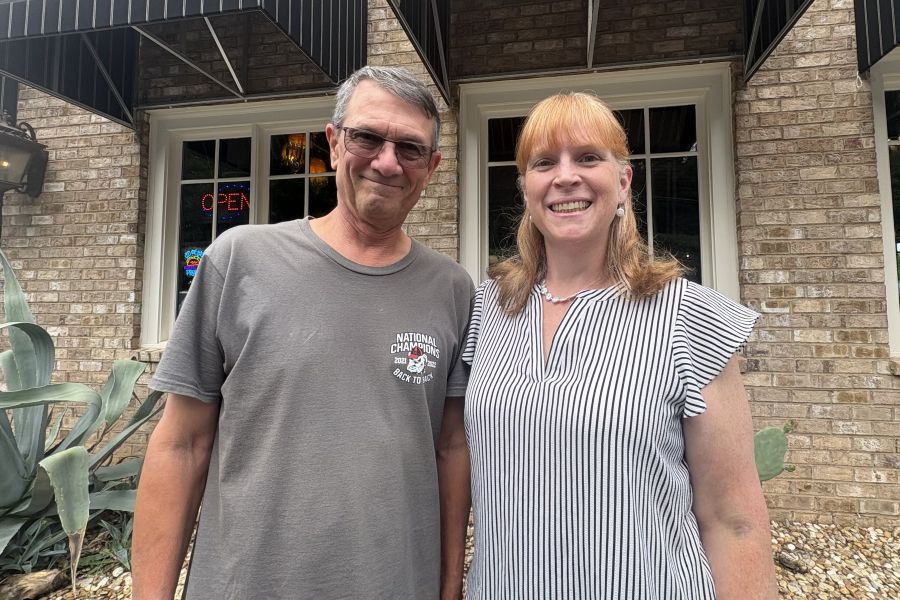
A recent afternoon on the tennis courts turned into a life-or-death emergency — and a powerful reminder of how preparation, teamwork and timing can save a life.
Machelle Rybicky, a Northside Hospital Gwinnett IV nurse, was playing a tennis match away from her home courts when she heard someone shouting for a nurse or doctor from nearby pickleball courts.
Without hesitation, Machelle dropped her racket and ran toward the call for help.
When she arrived, she found a man lying on the ground, unconscious, not breathing and without a pulse. She said his skin had turned ashen and blue, both signs that something was seriously wrong, and time was running out.
Machelle immediately got to work.
“Thankfully, the tennis courts had an AED,” she said, referring to an automated external defibrillator.
After the device determined he was in a shockable rhythm and delivered a shock, she began CPR. For about two minutes, Machelle performed chest compressions.
Then, John Hoppa — the man on the ground — took a deep breath.
Though initially disoriented, John, 70, was breathing and responsive as the ambulance arrived and took him to Northside Gwinnett. Waking up in the ambulance is all he remembers of the event, he said. Before that, his last memory was leaning over to pick up a ball.
John has since heard what transpired, and his doctors later told him the situation was dire.
“They said it was a catastrophic event,” he said. Things “wouldn’t have worked out” had it not been for the timing and the skills of the people who were there, his doctors told him.
In addition to Machelle, other bystanders stepped in to help, including someone familiar with the courts who knew where to retrieve the AED.
“There just happened to be all the right people there at the right time,” John said.
For Machelle, her response was instinctive and shaped by years of training and experience having previously worked in a cardiac intensive care unit. While she had performed chest compressions countless times, she said this was her first time doing it outside of a hospital setting.
She credits the AED as a critical factor in keeping her calm. The machine provides constant feedback, including how many seconds remain in the CPR cycle.
“That really helps in a situation like that,” she said.
That night, Machelle shared a brief reflection on social media, encouraging others to learn CPR and recognize the value of having AEDs readily available. The post caught the attention of a former tennis partner whom she hadn’t seen in years.
That person was John’s wife, Lois, who quickly connected the dots after seeing the post.
“I texted Machelle immediately and said, ‘You saved my husband’s life,’” Lois recounted.
Machelle had no idea John was her friend’s husband.
“I was just thankful I was able to help,” she said. “I didn’t feel like a hero. This is what we do as nurses. You just step in.”
But for both John and Lois, Machelle’s actions — and those of others who helped — felt nothing short of divine intervention.
“It gives me chills,” Lois said. “If this happened anywhere else, I don’t think he would be with us right now.”
At the hospital, John underwent a three-hour surgery to treat a blocked artery. He is now recovering at home and continuing follow-up care, which will include a second surgery to repair another blockage found during the initial procedure
“Northside Hospital Heart Institute took great care of him,” Lois said.
John has long been active, playing tennis for decades and recently took up pickleball. He said the experience has reinforced the importance of maintaining his healthy lifestyle. Now, he is focused on recovery and hopes to return to the activities he enjoys.
“I just feel blessed,” John said. “That’s more than just luck.”
LEARN MORE ABOUT NORTHSIDE HOSPITAL HEART INSTITUTE.
*The health story shared here is for informational purposes only and is not medical advice. Patients should consult with their own physician before making medical decisions.
