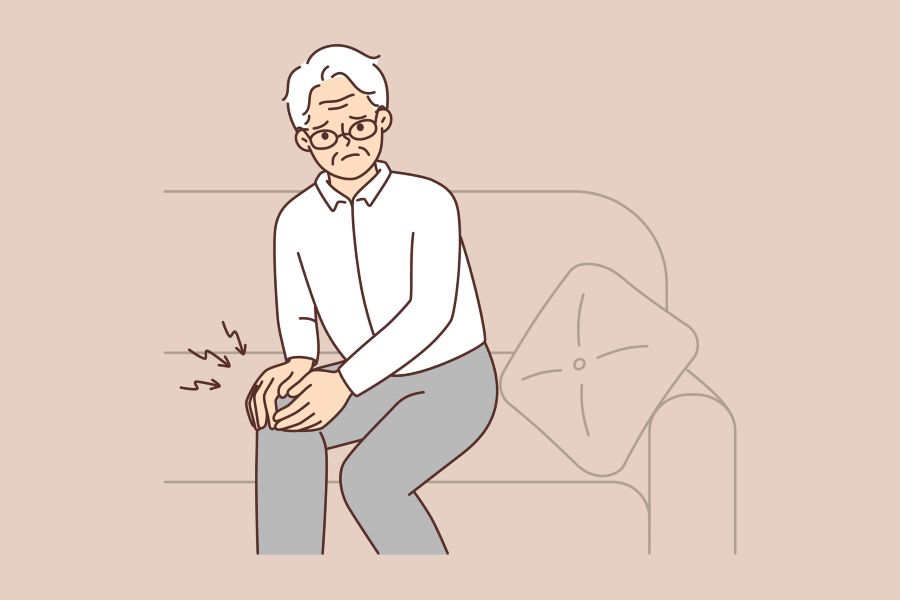
Snap, crackle, pop — kids hear it at breakfast. For older adults, the “Rice Krispies” can take on a whole new meaning.
Around 58.5 million U.S. adults have arthritis, a number expected to grow significantly as the nation’s population continues to age. By 2040, the Centers for Disease Control and Prevention predicted it will affect 78 million adults — causing hundreds of billions of dollars in health care costs and wage losses. Swollen joints, severe pain, limited range of motion — could it all start with a snap, crackle and pop?
“That cues us in that it could very well be arthritic,” Northside Hospital Orthopedics’ Candler Thomas, PA-C, told listeners on Northside’s Wellness Wednesday webinar series.
A specialist in knee, shoulder and upper extremity conditions, the Canton-based provider regularly treats North Georgia patients for arthritis and other joint issues. According to Thomas, the “Rice Krispies” has another name in the medical world — crepitus.
Why do my joints snap and pop like ‘Rice Krispies’ cereal?
Not always a sign something’s wrong, crepitus happens to everyone. Cracking your knuckles can cause tiny bubbles of nitrogen inside your joints to painlessly pop. Sometimes, the bone rubbing on bone or sliding against cartilage in your joints creates more than a pop though. If it also causes pain, the crepitus may be a sign of arthritis.
"When we talk about arthritis, it's like wearing the tread off a tire,” she said. “It's a progressive degeneration of cartilage over time. Why it happens, to whom it happens, and how quickly it happens are all hard to say.”
Arthritis comes in many forms. The degenerative joint disease osteoarthritis is the most common type, largely affecting older adults. Common symptoms include pain and stiffness after inactivity in the hands, knees, hips, neck or lower back.
A healthy joint, Thomas explained, is like a fresh paved road. It’s smooth and effective. After years of use, the damage can begin to show. This can lead to more snaps, crackles and pops in your day to day life, as those joints shift around.
“As you get older, or you get a little more wear and tear in the joint, it's almost like you have potholes,” she said. "Then eventually, when it’s bone on bone, it's almost like a gravel road.”
Hearing the “Rice Krispies” of crepitus in your knees can be a particularly telling sign.
"Driving down a gravel road, it's rough and it kind of hurts,” Thomas said. “So crepitus is one of the things that cues us in. Maybe this is a little arthritic change, especially behind that kneecap.”
Determining precisely what is behind joint pain can be difficult, however. The knee features many interior structures that can play a role.
"You have your quad tendon, patella tendon, ACL, PCL, MCL, meniscus tissue... so that deep joint pain can be very difficult to tell because it all looks the same,” she said. “The best way to really know is to come see one of us.”